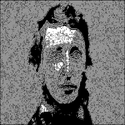
Henry David Thoreau
Full Name and Common Aliases
Henry David Thoreau, often referred to simply as Thoreau, was a prominent American writer, philosopher, and naturalist. His full name was David Henry Thoreau, but he later reversed his first and middle names, becoming known as Henry David Thoreau.
Birth and Death Dates
Henry David Thoreau was born on July 12, 1817, in Concord, Massachusetts, and he passed away on May 6, 1862, in the same town that he cherished throughout his life.
Nationality and Profession(s)
Thoreau was an American by nationality. He was a man of many talents, known primarily as a writer, philosopher, and naturalist. Additionally, he was a dedicated transcendentalist, a movement that emphasized the inherent goodness of people and nature.
Early Life and Background
Thoreau was born into a modest family in Concord, Massachusetts. His father, John Thoreau, was a pencil maker, and his mother, Cynthia Dunbar Thoreau, took care of the household. Thoreau had three siblings, and his family environment was one that valued education and intellectual pursuits. He attended Harvard College, where he studied a broad curriculum that included philosophy, rhetoric, and the classics. Despite his academic achievements, Thoreau was not particularly enamored with formal education, often finding it too rigid and uninspiring.
After graduating from Harvard in 1837, Thoreau returned to Concord, where he would spend most of his life. He worked in his father's pencil factory and briefly as a schoolteacher. However, his true passion lay in writing and exploring the natural world. His friendship with Ralph Waldo Emerson, a leading transcendentalist thinker, greatly influenced his philosophical outlook and literary career.
Major Accomplishments
Thoreau's major accomplishments are deeply intertwined with his philosophical beliefs and his commitment to living a life of simplicity and reflection. He is best known for his experiment in simple living at Walden Pond, where he built a small cabin and lived for two years, two months, and two days. This experience formed the basis of his most famous work, "Walden; or, Life in the Woods," published in 1854. In "Walden," Thoreau eloquently articulated his philosophy of self-reliance, individualism, and harmony with nature.
Another significant accomplishment was his essay "Civil Disobedience," originally titled "Resistance to Civil Government." Written in 1849, this essay argued for the importance of individual conscience and the moral imperative to resist unjust laws. Thoreau's ideas on civil disobedience would later inspire influential figures such as Mahatma Gandhi and Martin Luther King Jr.
Notable Works or Actions
Thoreau's literary contributions extend beyond "Walden" and "Civil Disobedience." He was a prolific writer, keeping detailed journals that chronicled his observations of nature and reflections on life. These journals, published posthumously, provide valuable insights into his thoughts and the development of his ideas.
In addition to his writing, Thoreau was an active participant in the abolitionist movement. He delivered lectures and wrote essays condemning slavery, including "A Plea for Captain John Brown," which defended the actions of the radical abolitionist. Thoreau's commitment to social justice and his willingness to speak out against injustice were integral to his character and legacy.
Impact and Legacy
Henry David Thoreau's impact on literature, philosophy, and social activism is profound and enduring. His writings have inspired generations of readers to seek a deeper connection with nature and to question societal norms. Thoreau's emphasis on living deliberately and authentically resonates with those who value simplicity and introspection in an increasingly complex world.
His ideas on civil disobedience have had a lasting influence on social and political movements worldwide. Leaders like Gandhi and King drew upon Thoreau's principles to advocate for nonviolent resistance and social change, demonstrating the universal applicability of his philosophy.
Why They Are Widely Quoted or Remembered
Thoreau is widely quoted and remembered for his eloquent and thought-provoking insights into the human condition and the natural world. His ability to distill complex ideas into memorable aphorisms has made his work a rich source of inspiration for those seeking wisdom and guidance. Quotes such as "The mass of men lead lives of quiet desperation" and "Rather than love, than money, than fame, give me truth" capture the essence of his philosophy and continue to resonate with readers today.
Thoreau's legacy as a champion of individualism, environmentalism, and social justice ensures that his words remain relevant and influential. His call to live deliberately and to prioritize personal integrity over societal expectations challenges us to reflect on our own lives and the world around us.
Quotes by Henry David Thoreau
Henry David Thoreau's insights on:

It is remarkable how many creatures live wild and free though secret in the woods.

Some interests have got a footing on the earth which we have not made sufficient allowance for.

It is usually the imagination that is wounded first, rather than the heart it being much more sensitive.

I once had a sparrow alight upon my shoulder for a moment while I was hoeing in a village garden, and I felt that I was more distinguished by that circumstance than I should have been by any epaulet I could have worn.

He is blessed over all mortals who loses no moment of the passing life in remembering the past.

As in geology, so in social institutions, we may discover the causes of all past changes in the present invariable order of society.

The sparrow seems always chipper, never infirm. We do not see their bodies lie about. Yet, there is a tragedy at the end of each one of their lives. They must perish miserably; not one of them is translated.


The tops of mountains are among the unfinished parts of the globe, whether it is a slight insult to the gods to climb and pry into their secrets and try their effect on our humanity. Only daring and insolent men, perchance, go there.
